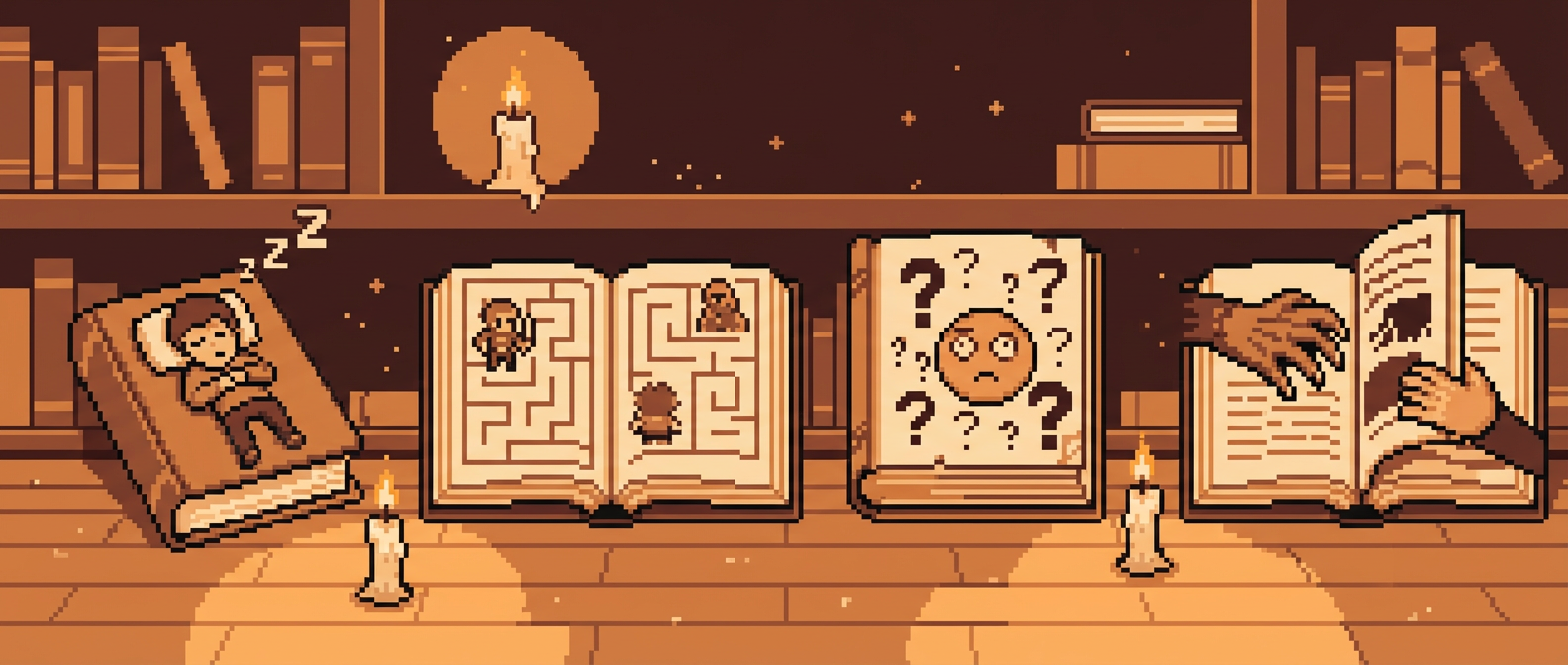
The Books That Beat Me: When DNF Becomes a Genre Study

The Literary Fiction That Felt Like Homework

I made it exactly 127 pages into 2666 before admitting defeat. Roberto Bolaño’s posthumous masterpiece sits on my shelf like a beautiful, intimidating monument to my own literary inadequacy. The prose is gorgeous, the scope ambitious, but somewhere around the fourth academic conference discussion about an obscure German writer, I realized I was reading it because I thought I should, not because I wanted to.

The Books That Beat Me: When DNF Becomes a Genre Study

This is literary fiction’s particular trap. The genre demands a certain intellectual rigor, a willingness to sit with discomfort and ambiguity. But those same demands can create distance between reader and text that feels impossible to bridge. When I compare my experience with 2666 to flying through The Left Hand of Darkness, I see how genre can either invite or exclude. Ursula K. Le Guin’s science fiction asks equally complex questions about humanity, but wraps them in narrative momentum that carries you forward even when the ideas challenge you.

The difference isn’t intelligence or sophistication. It’s about how genre conventions shape reader expectations and author obligations. Literary fiction often puts language and theme over plot, which works brilliantly when you’re in the right headspace. But when life is chaos and you need books to be refuge rather than work, those beautiful, meandering sentences can feel like walls instead of windows.

Illustration for The Books That Beat Me: When DNF Becomes a Genre Study

When Fantasy Worlds Became Too Much World

I abandoned Brandon Sanderson’s Mistborn trilogy halfway through the second book, and it wasn’t because the magic system was confusing. Actually, the opposite. Sanderson’s magic systems are marvels of internal logic and complexity, but they require constant mental bandwidth I didn’t have. Every scene demanded I remember seventeen different types of metals, their interactions, the political implications, the historical context.

Fantasy’s worldbuilding expectations have grown ridiculously elaborate. Readers want depth, consistency, full mythologies. But this creates books that function almost like textbooks, requiring active study rather than passive immersion. When I contrast this with something like Mary Stewart’s Merlin books, I see how earlier fantasy trusted readers to fill gaps with imagination rather than exposition.

The irony is that fantasy supposedly offers escape, but modern epic fantasy often demands more cognitive effort than literary fiction. The genre’s evolution toward complexity works beautifully for some readers but leaves others behind. I’m not arguing for simpler books, but acknowledging that genre conventions shape accessibility in ways we don’t always consider.

The Romance That Made Me Question Everything

I quit The Hating Game at 30% because I couldn’t handle watching Lucy let Josh treat her terribly while the narrative insisted this was romantic tension. This wasn’t about the genre’s happy ending requirement or its focus on relationship development. This was about how contemporary romance’s need to maintain sexual tension can sometimes override character agency in ways that make my skin crawl.

Romance operates within strict emotional frameworks that generally work beautifully. The promise of a satisfying relationship arc, the guarantee that love will triumph, the celebration of vulnerability and connection. But when those frameworks clash with modern understandings of healthy relationship dynamics, the reading experience becomes genuinely uncomfortable rather than escapist fun.

Comparing this to something like 99 Percent Mine shows how the same genre conventions can support entirely different power dynamics. Sally Thorne’s book maintains sexual tension while ensuring both characters maintain agency and self-respect. The constraint isn’t the problem. It’s how individual authors navigate within those constraints that determines whether a book works for any given reader.

The Thriller That Forgot to Thrill

I made it through three chapters of The Girl on the Train before realizing I fundamentally disagreed with the book’s approach to unreliable narration. Psychological thrillers live and die by their ability to maintain tension while gradually revealing truth. But when the unreliability feels manipulative rather than revelatory, when withheld information works for plot mechanics rather than character development, the whole structure collapses.

The need to build toward a big reveal shapes every choice in psychological thrillers. Every scene must either advance the mystery or deepen character complexity, ideally both. But this can create narratives that feel constructed rather than organic. When I compare my experience to reading Big Little Lies, I see how Liane Moriarty uses the same conventions to explore character rather than just puzzle-box plotting.

What DNFs Teach Us About Reading

These abandoned books aren’t failures, mine or theirs. They’re mismatches between what I needed as a reader and what these particular books offered within their genre conventions. Every genre develops patterns that work for specific reading experiences. Literary fiction encourages contemplation. Fantasy builds immersive worlds. Romance celebrates emotional connection. Thrillers generate suspense.

But those same conventions can exclude readers whose needs don’t align with genre expectations. The book I can’t finish in January might be exactly what I need in July. The romance that feels suffocating during a difficult relationship might offer perfect comfort when I’m secure. Context matters as much as content.

Understanding why books don’t work for us teaches us as much about reading as understanding why they do. It clarifies our tastes, identifies our needs, and helps us navigate the overwhelming number of available books. Plus, it reminds us that reading is supposed to be pleasurable, not performative. Sometimes the bravest thing you can do as a reader is admit when a book isn’t working for you and move on to one that will.

What books have you DNF’d, and what did they teach you about your reading preferences? I’m always curious about the stories behind our abandoned reads.

The Art of Author Discovery: Why Your Next Literary Obsession Is Hiding in Plain Sight

Stop Reading Like You’re Shopping

We’ve turned book discovery into a consumer experience. Amazon algorithms. BookTok trending lists. “If you liked X, try Y” recommendations that treat literature like a matching game. But here’s what I’ve learned after years of chasing the next great read: the authors who truly change us rarely arrive through obvious channels.

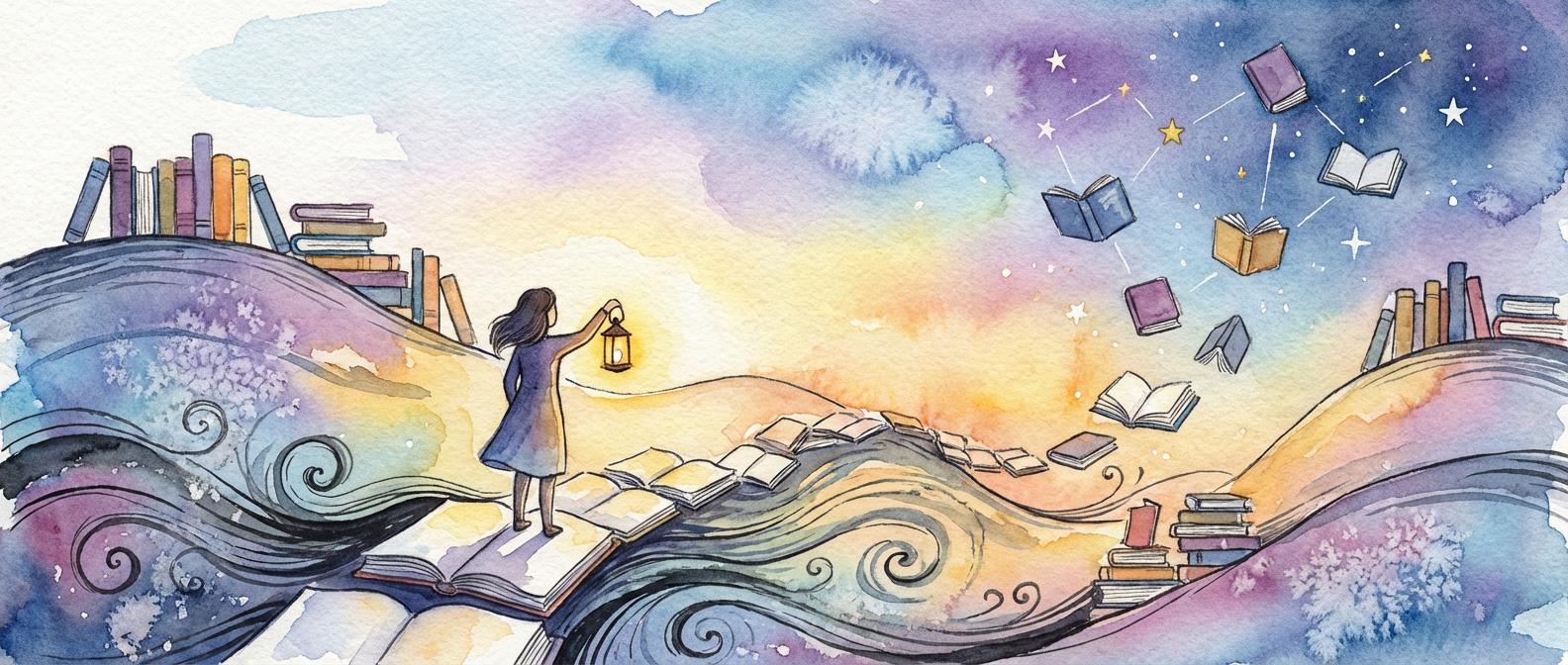
The Art of Author Discovery: Why Your Next Literary Obsession Is Hiding in Plain Sight

The best literary relationships start with a single sentence that stops you cold. Maybe it’s the opening line of Toni Morrison’s “Beloved”: “124 was spiteful.” Three words that contain an entire haunted universe. Or perhaps it’s stumbling across Annie Dillard’s precision in “Pilgrim at Tinker Creek,” where she writes about a mockingbird “like a scrap of gray paper blown by the wind.” These moments can’t be engineered by any algorithm.

The problem with recommendation engines? They optimize for similarity, not revelation. They’ll lead you to more books like the ones you’ve already read, keeping you in a comfortable literary echo chamber. But your next favorite author might write nothing like your current favorites. They might challenge everything you think you know about what good writing looks like.

Illustration for The Art of Author Discovery: Why Your Next Literary Obsession Is Hiding in Plain Sight

Follow the Sentence, Not the Synopsis

Forget plot summaries. Forget genre categories. Start reading for the quality of attention an author brings to their sentences. This is where you discover whether someone has something genuinely new to offer or if they’re just rearranging familiar furniture.

Take thirty seconds in the bookstore or library. Open to any random page and read a paragraph. Does the author see the world with fresh eyes? Do their sentences have weight? Can you hear a distinct voice emerging from the prose? Ocean Vuong writes: “Sometimes being offered tenderness feels like the very proof that you’ve been ruined.” That’s not just beautiful language. It’s a way of thinking about human experience that reorganizes how you understand vulnerability.

The authors worth following long-term make you slow down. They write sentences you want to reread not because they’re confusing, but because they’re dense with meaning. They understand that style isn’t decoration, it’s how thought becomes visible on the page.

Don’t trust reviews that focus only on what happens in a book. Trust the ones that quote actual sentences and explain why they matter. Pay attention to how an author handles small moments, ordinary observations, quiet transitions between scenes. That’s where you’ll find their true voice.

Embrace the Uncomfortable Introduction

Your next favorite author might initially feel wrong to you. Maybe their pacing seems too slow. Maybe their narrative structure feels unfamiliar. Maybe their preoccupations don’t match yours. Good. Discomfort often signals growth.

I remember picking up Rachel Cusk’s “Outline” and feeling frustrated by its unconventional approach to storytelling. No traditional plot. Just conversations that somehow accumulated into something profound about how we construct meaning from other people’s narratives. I had to adjust my reading expectations, slow down, and trust the author’s vision. Now I consider Cusk essential.

The same thing happened with László Krasznahorkai, whose breathlessly long sentences initially overwhelmed me. Or with Jenny Erpenbeck, whose time-shifting narratives demanded a different kind of attention than I was used to giving. These authors didn’t meet me where I was, they asked me to come to them. The effort was worth it.

Some of the most rewarding reading experiences come from authors who expand your definition of what literature can do. They might experiment with form, play with language in unexpected ways, or approach familiar themes from angles you haven’t considered. Don’t dismiss these experiments as pretentious. Ask yourself: what is this author trying to achieve that couldn’t be accomplished through conventional means?

Trust the Long Game

Building a relationship with an author’s work takes time. You can’t judge someone’s entire output based on a single book, especially if it’s the one that happened to get the most attention. Sometimes an author’s masterpiece is their third novel, not their acclaimed debut. Sometimes their early work reveals ambitions that only fully flower in later books.

Consider how your understanding of a writer deepens across multiple books. With each new work, you start to recognize their recurring obsessions, their evolving style, their growing mastery of their craft. You start to see connections between their different projects. You develop the ability to appreciate not just what they’re saying, but how their way of saying it has developed over time.

This is why I always read at least two books by an author before deciding whether they’re worth following. The first book shows you their current capabilities. The second shows you their range and trajectory. Are they repeating themselves or pushing into new territory? Are they refining their voice or recycling successful formulas?

Keep notes on authors who intrigue you, even if you’re not immediately converted. Sometimes the right book by an author is the fourth one you try, not the first. Sometimes you need to grow as a reader before you’re ready for what they’re offering.

Create Your Own Discovery System

Develop personal strategies for finding authors outside the mainstream recommendation cycle. Follow translators whose choices you trust, they often introduce English-language readers to essential international voices. Pay attention to which authors blurb each other’s books. These networks reveal aesthetic connections that algorithms miss.

Literary magazines are goldmines for discovering emerging voices before they publish their first books. Subscribe to publications like Granta, The Paris Review, or smaller journals that align with your interests. Read the contributors’ notes and seek out their other work. Often, the author who writes the most compelling short story in an issue has a novel worth tracking down.

University presses publish some of the most interesting literary work being done today, often by authors who won’t appear on bestseller lists but deserve serious attention. New Directions, Coffee House Press, and Graywolf Press consistently champion innovative voices. Browse their catalogs like you would explore a thoughtfully curated art gallery.

The goal isn’t to read more books, it’s to read more deeply and diversely. Quality of attention matters more than quantity of consumption. Your next favorite author is out there, probably working in a mode you haven’t yet learned to appreciate, waiting for the moment when your readiness meets their vision. What sentences are calling to you today?

When Your Literary Heroes Let You Down (And Why That’s Actually Good)

The Great Disappointment

You know that sinking feeling when you crack open the latest book by an author you’ve worshipped for years, only to find yourself three chapters in wondering if someone else wrote it? I’ve been there. We’ve all been there. Last month it was Colson Whitehead’s Crook Manifesto for me—after the devastating brilliance of The Underground Railroad, I expected lightning to strike twice. Instead, I got a competent crime novel that felt like he was sleepwalking through the genre.

When Your Literary Heroes Let You Down (And Why That's Actually Good)
When Your Literary Heroes Let You Down (And Why That’s Actually Good)

The betrayal cuts deep because reading is so personal. When we fall in love with an author’s voice, we’re not just connecting with their words, we’re trusting them with our time, our emotions, our late nights and early mornings. We become evangelists, pressing their books into friends’ hands and saying “You have to read this.” So when they stumble, it feels like a personal rejection.

But here’s what I’ve learned after decades of literary heartbreak: disappointment isn’t just inevitable, it’s necessary. The authors who never disappoint you are probably playing it safe. The ones who occasionally crash and burn? Those are the risk-takers, the boundary-pushers, the writers who refuse to write the same book over and over again.

Illustration for When Your Literary Heroes Let You Down (And Why That's Actually Good)
Illustration for When Your Literary Heroes Let You Down (And Why That’s Actually Good)

The Sophomore Slump and Beyond

Some disappointments are predictable. The dreaded sophomore novel has claimed countless victims—authors whose debut was so stunning that anything following feels like a pale imitation. Emma Straub’s The Vacationers after Laura Lamont’s Life in Pictures. Hanya Yanagihara’s To Paradise after the gutting perfection of A Little Life. These aren’t bad books, exactly, but they’re shadows of what came before.

Then there are the late-career puzzlers. What do you do when an author you’ve followed for twenty years suddenly takes a hard left turn? Margaret Atwood writing The Heart Goes Last felt like watching your brilliant professor aunt get really into conspiracy theories. Joyce Carol Oates’s recent output reads like someone doing a Joyce Carol Oates impression. These shifts can be jarring, even insulting to longtime readers who feel like they’re owed consistency.

But maybe that’s our mistake. Maybe we’re the ones being unfair, demanding that artists remain frozen in time like insects in amber. Writers are humans, not content-generating machines. They get bored. They experiment. They have midlife crises and creative breakthroughs and personal disasters that reshape their worldview.

When Politics and Art Collide

Sometimes the disappointment isn’t about craft, it’s about character. Learning that Orson Scott Card holds views that seem fundamentally opposed to the empathy in Ender’s Game creates cognitive dissonance that’s hard to resolve. J.K. Rowling’s Twitter presence has made many readers question their relationship with Harry Potter. Can you separate art from artist? Should you?

I don’t think there’s a universal answer. For some readers, discovering that a beloved author holds reprehensible views ruins the magic forever. Others compartmentalize, arguing that books should be judged on their own merits. Both responses are valid, but both are also incomplete.

What interests me more is how these revelations force us to examine our own reading practices. Were we reading what we wanted to see rather than what was actually on the page? Were there warning signs we ignored because we were so invested in our image of the author? Sometimes author disappointment is really reader disillusionment, the moment we realize we were projecting our own values onto someone else’s work.

The Gift of Literary Letdown

Here’s my controversial take: being disappointed by beloved authors is good for you as a reader. It forces you to figure out what you actually value in literature beyond brand loyalty. It makes you a more critical, more thoughtful consumer of books. And most importantly, it opens up space for new voices.

When Tana French’s The Witch Elm left me cold after years of loving her Dublin Murder Squad series, I had to ask myself what I’d been getting from those earlier books. Was it just the formula I liked, or something deeper? The answer led me to discover writers like Sarah Waters and Kate Atkinson, whose approach to crime fiction scratched the same itch in different ways.

Disappointment also teaches resilience. Not every book will be for you, even from authors you adore. That’s not a failure on anyone’s part, it’s just how art works. The alternative is creative stagnation, where authors keep churning out pale imitations of their greatest hits until both they and their readers are bored to tears.

And sometimes, disappointment is temporary. Books that left me cold on first reading have surprised me years later when I returned with different expectations or life experiences. Anne Enright’s Actress annoyed me when it first came out because it wasn’t another The Gathering. Rereading it last year, I appreciated its ambition and strange beauty in ways I couldn’t before.

Moving Forward with Open Hearts

So what do you do when a favorite author lets you down? First, sit with the disappointment. Examine it. What specifically bothered you? Was it a departure from their usual style, a drop in quality, or something else entirely? Understanding your reaction helps you understand your own reading preferences better.

Then, decide whether to give them another chance. Some authors are worth following through rough patches, their hits are so transcendent that the misses feel like necessary experiments. Others might have run their course for you, and that’s okay too. Reading is not a marriage. You’re allowed to break up.

Most importantly, use disappointment as a catalyst for discovery. Every beloved author who has let me down has accidentally led me to three new favorites. Literary disappointment is rarely the end of the story, it’s usually the beginning of a new chapter in your reading life.

Have you had your heart broken by a favorite author recently? I’d love to hear about it. Sometimes the best conversations about books come from the ones that didn’t work for us. They reveal so much about what we’re really looking for when we crack open a cover and dive in.

The Books That Time Forgot (And Maybe Deserved To)

When Literary Archaeology Gets Messy

I spend way too much time in the dusty corners of used bookstores, pulling forgotten novels from shelves like some kind of literary archaeologist. You know the ones: beautiful covers, intriguing premises, authors you’ve never heard of despite their apparent prolificacy in 1987. Sometimes I strike gold. More often, I understand exactly why these books vanished into obscurity.

The Books That Time Forgot (And Maybe Deserved To)

But here’s the thing about forgotten books that everyone seems to miss in those wistful “they don’t write them like this anymore” essays. Some books disappeared for good reasons. Bad plotting, wooden dialogue, or premises that seemed brilliant in 1973 but aged like milk in sunlight. The real skill isn’t just excavating buried treasures, it’s distinguishing between books that were overlooked and books that were correctly filed under “thanks, but no thanks” by literary history.

I’ve been keeping what I call the Deserved Obscurity Test for years now. Three questions: Does this book do something genuinely distinctive that wasn’t being done elsewhere at the time? Does it hold up when stripped of nostalgic context? And most importantly, would I actually recommend this to someone I like, or am I just impressed by my own archaeological skills?

Illustration for The Books That Time Forgot (And Maybe Deserved To)

The Case for Ruth Ozeki’s “My Year of Meats”

Let me start with a book that absolutely passes the test: Ruth Ozeki’s “My Year of Meats” from 1998. This novel about a Japanese-American documentarian investigating the American meat industry for a Japanese cooking show should have been everywhere. Instead, it got respectful reviews, a modest readership, and then promptly disappeared from most literary conversations despite tackling everything from cultural imperialism to environmental destruction to domestic violence.

What makes this book remarkable isn’t just its prescient environmental themes or its complex portrayal of cross-cultural relationships. It’s the way Ozeki weaves together a biting satire of American consumer culture with genuine emotional stakes. The protagonist, Jane, isn’t just uncovering corporate malfeasance. She’s navigating her own identity as a mixed-race woman caught between cultures, while her Japanese counterpart, Akiko, finds unexpected strength through American television and a growing awareness of her own agency.

This book predicted so many conversations we’re having now about food systems, cultural appropriation, and global capitalism. But it did so through characters who feel like real people rather than mouthpieces for ideas. Ozeki later gained recognition for “A Tale for the Time Being,” but “My Year of Meats” is her most structurally ambitious work. It deserved better than literary limbo.

The Beautiful Failures Worth Revisiting

Then there are books like Maureen Howard’s “Natural History” from 1992, which won the PEN/Faulkner Award and promptly vanished. Howard attempted something wildly ambitious: a novel structured like a natural history museum, with each section examining different specimens of American life. The execution is uneven, sometimes brilliant, sometimes frustratingly opaque. But the failure is so interesting, so clearly the work of a writer pushing boundaries rather than playing it safe.

These books fascinate me more than the genuinely overlooked masterpieces, because they reveal something about literary risk-taking. Howard was trying to do something that hadn’t been done before, and while it doesn’t entirely work, it works enough to make you wonder what contemporary fiction would look like if more writers were willing to fail this interestingly.

Similarly, there’s Victor LaValle’s “The Ecstatic” from 2002, a novel about a young Black man’s mental health crisis that combines family drama with surreal elements in ways that shouldn’t work but absolutely do. LaValle has since become well-known for his horror fiction, but this early novel is his most emotionally raw work. It disappeared not because it wasn’t good, but because it defied easy categorization in a market that rewards clear genre boundaries.

The Deserved Obscurity Hall of Fame

Now let’s talk about the books that failed the test spectacularly. I spent three weeks tracking down a copy of “The Passion Dream Book” by Whitney Otto after reading a glowing retrospective essay. The premise sounded intriguing: interconnected stories about women across different time periods, all connected by dreams and desire. The execution? Pretentious beyond belief, with purple prose so thick you could cut it with a knife.

This is where the Deserved Obscurity Test becomes important. Yes, Otto was attempting something ambitious about female sexuality and historical connection. But good intentions don’t excuse poor craft. The dialogue reads like bad poetry, the connections between stories feel forced, and the whole thing reeks of an author who confused obscurity with profundity.

The same goes for most of those “lost masterpieces” you see recommended in listicles about forgotten books. Half of them are forgotten because they’re genuinely mediocre works that happened to be published during slow news cycles when critics were generous with their praise. The other half are books that tackled controversial subjects and got confused for being more sophisticated than they actually were.

Why Literary Archaeology Matters Anyway

So why do this work at all if so many excavated books turn out to be fool’s gold? Because the few genuine discoveries make it worthwhile. Finding a book like Ozeki’s “My Year of Meats” or LaValle’s “The Ecstatic” reminds you that literary merit and commercial success don’t always align. These books expand your sense of what fiction can do, often in ways that feel more urgent and necessary than whatever’s currently dominating the bestseller lists.

More importantly, these forgotten books reveal the arbitrary nature of literary reputation. They show you how much of what we consider “classic” or “important” depends on timing, marketing, and pure chance. A book’s disappearance from cultural conversation doesn’t necessarily reflect its quality any more than its initial prominence guaranteed its lasting value.

The real reward of literary archaeology isn’t proving that we’ve lost touch with some golden age of fiction. It’s discovering that every era produces both masterpieces and dreck, and that the sorting process is far less systematic than we’d like to believe. Sometimes the best books do rise to the top. Sometimes they get buried under other people’s mediocrity and have to wait for readers like us to dig them up again.

What forgotten books have you stumbled across that passed or failed your own version of the test? I’m always looking for recommendations from fellow literary archaeologists, especially if you can make a case for why something deserves resurrection.

Lost in Translation (and Found Again): Your Guide to Reading Across Languages This Season

Why Translation Matters More Than You Think

I need to tell you something that might change how you read forever. Last week I picked up The Seventh Cross by Anna Seghers in two different English translations, published decades apart. Same German source text. Completely different books in English. One translator rendered the protagonist’s internal monologue as choppy, fragmented thoughts. The other chose flowing, literary prose. Both were “accurate.” Both were art.

Lost in Translation (and Found Again): Your Guide to Reading Across Languages This Season

This is the translation question that keeps me up at night. When you fall in love with Elena Ferrante or Haruki Murakami, are you falling for the author or the translator? The answer is both, and that’s what makes reading translated literature so thrilling. You’re not just getting one artist’s vision. You’re getting a conversation between two creative minds across languages, cultures, and sometimes centuries.

As we slide into the season of longer nights and deeper reading, I want to share some translations that show just how powerful this art form can be. These aren’t just good books that happen to be translated. They’re books where the translation itself becomes part of the magic.

Illustration for Lost in Translation (and Found Again): Your Guide to Reading Across Languages This Season

When Translators Become Literary Heroes

Let’s start with Constance Garnett, who single-handedly brought Russian literature to English readers in the early 1900s. Her Crime and Punishment shaped how we think about Dostoevsky for generations. But here’s the thing: Garnett sometimes smoothed over Dostoevsky’s deliberately clunky, neurotic prose style. She made him more palatable to English readers by making him less Russian. Revolutionary for its time, yes. Problematic by today’s standards, absolutely.

Now compare that to Richard Pevear and Larissa Volokhonsky’s recent retranslation of the same novel. They preserve Dostoevsky’s awkwardness, his repetitions, his manic energy. Reading their version feels like being trapped inside Raskolnikov’s fevered brain. It’s less comfortable than Garnett’s version, but it’s probably closer to what Russian readers experience.

This winter, try reading both versions of your favorite Russian classic. Notice how different translation choices create entirely different reading experiences. Garnett’s Brothers Karamazov versus Pevear and Volokhonsky’s version is like comparing a well-tailored suit to raw, unfinished wood. Both have their place, but they serve different purposes entirely.

The Poetry Problem and Other Translation Mysteries

Poetry translation is where things get really wild. How do you translate a haiku and preserve both meaning and form? How do you render Pablo Neruda’s passionate Spanish into equally passionate English without losing the music?

Take W.S. Merwin’s translations of Neruda versus Mark Eisner’s more recent work. Merwin, a poet himself, creates English poems that sing on their own terms. Eisner, focused on scholarly accuracy, stays closer to the literal meaning. Reading both versions of Twenty Love Poems and a Song of Despair is like hearing two different musicians perform the same composition. Same notes, completely different emotional impact.

For your seasonal reading, I recommend diving into Anne Carson’s translation of Sappho’s fragments. Carson doesn’t try to fill in the gaps where the ancient papyri have decayed. Instead, she leaves brackets around missing words, creating a haunting visual representation of time’s destruction. It’s translation as archaeology, translation as art installation.

Or try Don Mee Choi’s translation of Kim Hyesoon’s Korean poetry, which deliberately breaks English grammar to mirror the Korean experience of living between languages. It’s disorienting and beautiful. Like reading poetry through a funhouse mirror that somehow reveals more truth than a straight reflection.

Contemporary Voices Breaking Translation Rules

The most exciting translation work happening right now throws old rules out the window. Jennifer Croft’s translation of Olga Tokarczuk’s Flights reads like it was written in English first, but it preserves the Polish author’s distinctive fragmentary structure and philosophical depth. Croft doesn’t just translate words. She translates the rhythm of thought itself.

Then there’s Anton Hur’s translation of Sang Young Park’s Love in the Big City, which captures not just Korean slang but the attitude behind it. Hur finds English equivalents that preserve the snark, the vulnerability, the specifically queer Korean millennial voice that makes the original so powerful. It’s translation as cultural bridge-building.

For something completely different, pick up Yoko Tawada’s work. She’s a Japanese author who writes in German, then works with translators to bring her books into English. Her novel The Emissary exists in this weird linguistic limbo, where translation becomes part of the creative process rather than something that happens after the fact.

Building Your Translation-Conscious Reading Life

Here’s what I want you to do this season: start paying attention to translators’ names. Read their acknowledgments and afterwords. Many translators are scholars, poets, and cultural historians who bring their own expertise to the text. Edith Grossman’s afterword to her Don Quixote translation is a masterclass in translation theory. Lydia Davis’s notes on translating Flaubert reveal how much detective work goes into rendering 19th-century French psychology into contemporary English.

Try this experiment: pick an author you love who writes in a language you don’t speak. Find two different English translations of the same work. Read them back-to-back. Notice what each translator emphasizes, what they sacrifice, what they bring to the text. You’ll never read translated literature the same way again.

Some publishers are getting better at crediting translators prominently on covers and in marketing. Europa Editions, New Directions, and Archipelago Books treat translation as the art form it is. Support these publishers when you can.

Translation isn’t just about making foreign books accessible. It’s about expanding what English can do, what stories we can tell, what ways of thinking we can express. Every great translation makes our language richer. This season, as you’re choosing what to read by the fire or on those long commutes, consider picking up something that will challenge not just your ideas about story and character, but your ideas about language itself. Trust me, you’ll want to call someone at midnight when you finish, because I guarantee you’ll have thoughts you need to share.

Lost in Translation, Found in Beauty: Five Foreign Gems You’re Missing

Why Translation Matters More Than You Think

Listen, I need to tell you something that might sound controversial: some of the best books you’ll ever read weren’t written in English. I know, I know. We’re drowning in English-language releases, and who has time to venture into translated territory? But here’s the thing about translation—it’s not just swapping words from one language to another. It’s cultural archaeology. It’s emotional interpretation. It’s one writer channeling another writer’s soul across linguistic borders.

Lost in Translation, Found in Beauty: Five Foreign Gems You're Missing
Lost in Translation, Found in Beauty: Five Foreign Gems You’re Missing

The translator becomes a kind of literary medium, and when they’re good—really good—they don’t just preserve meaning. They create new magic. Think about it: every translated book you read is actually a collaboration between two artists, separated by language but united by story. That’s pretty incredible when you stop to consider it.

So tonight, instead of reaching for that familiar spine on your shelf, let me introduce you to five translated novels that have been keeping me up way past my bedtime. These aren’t your typical “literary darling” translations that everyone talks about. These are the quiet masterpieces, the ones that slip through the cracks while we’re all debating the latest Booker shortlist.

Illustration for Lost in Translation, Found in Beauty: Five Foreign Gems You're Missing
Illustration for Lost in Translation, Found in Beauty: Five Foreign Gems You’re Missing

The Haunting Precision of Kamel Daoud

“The Meursault Investigation” by Algerian writer Kamel Daoud, translated by John Cullen, is what happens when someone reads Camus and says, “But what about the other guy?” It’s a response to “The Stranger” that examines the unnamed Arab victim, and it’s absolutely devastating in its intelligence. Daoud writes with this crystalline clarity that cuts through decades of literary assumption.

What makes Cullen’s translation exceptional is how he preserves Daoud’s rhythm. These long, hypnotic sentences mirror the original French structure while feeling completely natural in English. The prose flows like consciousness itself, circular and obsessive. When the narrator declares, “I’ll tell you about this murder the way it should be told,” you feel the weight of historical correction, the urgency of finally speaking truth.

This isn’t just postcolonial literature doing its thing. This is a masterclass in how translation can bridge cultural gaps without erasing them. Cullen doesn’t smooth over the cultural specificity. He lets you feel like a respectful guest in someone else’s worldview. It’s the kind of book that makes you realize how much perspective we lose when we only read within our own linguistic borders.

Dorthe Nors and the Art of Emotional Minimalism

“So Much for That Winter” by Danish writer Dorthe Nors, translated by Misha Hoekstra, is two linked novellas that capture loneliness with such surgical precision it made me want to call every single person in my contacts just to hear another human voice. Nors writes about isolation in a way that’s both specifically Scandinavian and universally recognizable.

Hoekstra’s translation deserves special recognition for capturing what I can only describe as the texture of Danish melancholy. There’s something about Nordic languages that carries emotional weight differently than English, and Hoekstra manages to preserve that particular gravity. The prose feels spare without being cold, intimate without being sentimental.

In “Days,” we follow a woman whose life has become uncomfortably small, and Nors tracks her internal weather with meteorological precision. The beauty is in what’s not said, in the spaces between thoughts. This is minimalism that trusts its readers completely. Hoekstra’s translation honors that trust by never over-explaining or adding unnecessary emotional signposting.

The Wild Imagination of Han Kang’s Translator

Everyone knows “The Vegetarian,” but Han Kang’s “The White Book,” translated by Deborah Smith, is where things get really interesting from a translation perspective. This isn’t a novel in any traditional sense. It’s a meditation on whiteness, loss, and memory structured around white objects. It reads like poetry disguised as prose, and Smith’s translation walks this incredible tightrope between accessibility and strangeness.

Smith takes risks that could have gone horribly wrong. Korean and English have fundamentally different relationships with directness, metaphor, and emotional expression. Where Korean can be elliptical, Smith sometimes chooses clarity. Where English tends toward explanation, she preserves mystery. The result feels like reading someone’s beautiful, broken thoughts in real time.

The book opens with salt, moves through snow, contemplates rice. Each white object becomes a meditation on survival and fragility. Smith’s translation makes you feel the weight of cultural specificity, the way grief manifests differently across cultures, while never making you feel excluded from the emotional core. It’s translation as empathy.

César Aira and the Joy of Untranslatability

“Ghosts” by Argentine writer César Aira, translated by Chris Andrews, is 87 pages of pure literary weirdness that demonstrates why some books can only exist in translation. Aira writes these compact, surreal narratives that feel like fever dreams. Andrews has found a way to make the absurd feel inevitable in English.

The plot involves construction workers, ghosts, and a middle-class family, but plot is almost beside the point. Aira’s genius lies in his ability to make the impossible feel mundane and the mundane feel impossible. Andrews captures this by maintaining Aira’s matter-of-fact tone even when describing completely bonkers supernatural events.

What’s fascinating about this translation is how Andrews deals with Aira’s particular brand of Latin American surrealism. He doesn’t try to domesticate the strangeness or explain the cultural references that might be lost on English-speaking readers. Instead, he lets you exist in a state of productive confusion, trusting that the emotional logic will carry you through even when the literal logic falls apart.

Finding Your Next Translated Obsession

Here’s what I love about reading translated literature: it expands your emotional vocabulary in ways you don’t expect. These books teach you new ways to think about familiar feelings, new rhythms for processing experience. They remind you that literature is a conversation happening across borders. Translation is what lets us eavesdrop on the most interesting parts.

I’m curious about your relationship with translated books. Do you seek them out deliberately, or do they find you by accident? Have you ever fallen in love with a translator’s work as much as the original author’s? Drop me a line and tell me about the last translated book that kept you up way too late, thinking about the strange magic of words crossing borders to find new homes in your head.

When Words Fall Flat: Breaking Free from Reading Slumps Through Translation

The Peculiar Silence of a Reading Brain at Rest

You know that feeling when you open a book and the words just sit there on the page like strangers at a party? When sentences that should flow like water feel thick as honey, and even your most beloved authors sound like they’re speaking through cotton? Welcome to the reading slump, that mysterious literary purgatory where books become decoration and your nightstand pile grows accusingly taller.

When Words Fall Flat: Breaking Free from Reading Slumps Through Translation

I’ve been thinking about this lately because I just crawled out of a three-week reading drought that left me questioning everything. Was I losing my love for books? Had I finally read myself into some kind of literary saturation point? Then I picked up Yoko Ogawa’s “The Memory Police” in its English translation, and something clicked back into place. Not because the story was particularly uplifting (honestly, it’s pretty unsettling), but because the language felt different. Fresh. Like hearing a familiar song performed by a completely different artist.

That’s when it hit me: sometimes we don’t need different stories. We need different voices telling them.

Translation as Literary CPR

Here’s the thing about reading slumps that nobody talks about enough. We get stuck in linguistic patterns. After months of consuming books written in a particular style of English, our reading brains develop these tiny grooves, like a record player needle following the same track. We start anticipating sentence structures, predicting rhythms, and somewhere along the way, the magic of surprise disappears.

Translation throws a beautiful wrench into this machinery. Even the most skilled translator brings their own linguistic DNA to a text. When Lydia Davis translates Flaubert, you’re not just reading Flaubert. You’re reading Flaubert filtered through Davis’s precise, almost mathematical approach to language. When Constance Garnett translated Dostoevsky, she created a particular English-language Dostoevsky that influenced generations of readers and writers.

This isn’t a problem with translation. It’s actually the best part. Each translation is basically a creative collaboration between two writers separated by time, space, or both. The result? Prose that follows different rules, breathes differently, surprises you in ways that shake your reading brain back to attention.

How Language Refreshes Your Brain

When I was deep in my recent slump, I realized I’d been reading almost exclusively contemporary American literary fiction for months. Same sentence structures. Same cultural references. Same underlying assumptions about how English should move across a page. My reading palate had become as dulled as someone eating the same meal for weeks.

Then came Ogawa, translated by Stephen Snyder. The sentences had this particular weight to them, a gravity that felt distinctly not-English in origin. Characters didn’t “feel sad” – they experienced “a heaviness settling in their chest like snow.” Time moved differently. Conversations carried pauses that felt meaningful rather than awkward. It was still English, but English wearing different clothes.

The same thing happened when I moved from that into César Aira’s “Ghosts,” translated by Chris Andrews. Suddenly I was reading sentences that seemed to change direction mid-thought, not because they were poorly constructed, but because they followed the logic of a different language entirely. Spanish allows for longer, more meandering sentences than English typically tolerates. Andrews preserved that rhythm, creating prose that felt like taking a linguistic adventure.

This is why translation can be such powerful medicine for reading slumps. Sure, it gives you access to stories from other cultures, but there’s something more specific happening. It gives you access to other ways of thinking about language itself.

Beyond the Obvious Suspects

Everyone suggests the same escape routes from reading slumps: try a different genre, read poetry, pick up something light and fun. All valid advice. But translation offers something more specific: a way to stay within your preferred genres while completely changing the linguistic landscape.

Love psychological thrillers but feeling burned out on the usual suspects? Try Keigo Higashino translated by Alexander O. Smith, where the pace and revelation patterns follow Japanese storytelling traditions. Tired of contemporary literary fiction? Clarice Lispector, translated by Katrina Dodson, will completely rewire how you think about interiority and time.

The key is paying attention to the translator as much as the original author. Different translators have different approaches, different strengths, different philosophies about what translation should preserve versus what it should adapt. Ann Goldstein’s Elena Ferrante feels different from Michael Henry Heim’s Milan Kundera, which feels different from Julie Rose’s Victor Hugo.

Start treating translators like you treat authors. They’re artists whose particular vision shapes the reading experience. When you find a translator whose approach clicks with you, follow their work across different original authors. You might discover that what you thought was a preference for certain writers was actually a preference for certain ways of working with language.

Building Translation Into Your Reading Life

Building translation into your regular reading diet isn’t just about escaping slumps. It’s about preventing them. When your reading brain gets used to processing different syntactic patterns, different approaches to description and dialogue, different cultural frameworks for storytelling, it stays more flexible. More curious. Less likely to settle into those comfortable grooves that eventually become ruts.

I’ve started keeping what I call a “translation queue” – a list of books in translation that I turn to whenever my reading starts feeling too familiar. It’s not about being a completist or trying to read the whole world. It’s about maintaining linguistic agility.

The beautiful paradox of reading translated literature is that it can feel both utterly foreign and deeply familiar at the same time. You recognize the human experiences being described – love, loss, fear, joy – but encounter them expressed through the particular music of another language, filtered through another writer’s sensibilities.

So the next time words start feeling flat and your reading brain goes quiet, don’t just reach for a different book. Reach for a different language wearing English clothes. Trust me, your neurons will thank you.

What’s the most linguistically surprising translated book you’ve read lately? I’m always looking for recommendations that might shake up my next potential slump.

When Fantasy Writers Do Crime Better Than Crime Writers (And Other Genre Border Crossings You’re Missing)

The Magician’s Sleight of Hand

I picked up The Goblin Emperor expecting court intrigue with pointy ears. What I got was a masterclass in political thriller pacing that most Washington D.C. novels can’t touch. Katherine Addison didn’t just write fantasy, she wrote the most psychologically acute study of institutional power I’ve read since All the King’s Men. Every conversation crackles with the tension of someone navigating a system designed to crush them.

This is what happens when writers trained in one genre’s constraints tackle another genre’s problems. Fantasy writers understand world-building at the granular level. They know that power structures need internal logic, that every rule creates its own rebellion. When Addison applies that precision to political maneuvering, she exposes how sloppy most “literary” political fiction actually is.

Genre constraints aren’t limitations. They’re training wheels for techniques that work everywhere. The question isn’t whether you like fantasy, it’s whether you’re willing to learn about power from someone who’s had to construct it from scratch.

Romance Writers and the Architecture of Desire

Talia Hibbert’s Get a Life, Chloe Brown does something most literary fiction fails at: it shows how people actually change. Not through epiphany or tragedy, but through the messy, incremental work of choosing differently every day. Romance writers understand character development because they have to. Their entire genre depends on two people becoming worthy of each other over 300 pages.

Literary fiction often treats desire as either transcendent or destructive, rarely as the practical force that actually shapes our daily decisions. Hibbert maps the geography of attraction with the precision of a surveyor. She knows that falling in love means learning someone’s textures, their particular brand of damage, their specific way of being brave.

Meanwhile, half the novels on prize longlists have protagonists who seem incapable of wanting anything concrete enough to pursue. Romance writers can’t afford that luxury. They’re anthropologists of longing, and their field notes are more accurate than most literary observations about how people actually connect.

Mystery’s Laboratory for Social Autopsy

Oyinkan Braithwaite’s My Sister, the Serial Killer uses crime fiction’s structure to perform surgery on family loyalty. The murder mystery format forces every relationship to reveal its true anatomy under pressure. What looks like a darkly comic thriller is actually a devastating examination of how women are trained to enable each other’s worst impulses in the name of love.

Crime fiction demands consequences. Every action creates a reaction that characters must navigate or face destruction. This makes it perfect for writers who want to examine social systems without the luxury of literary fiction’s endless interiority. When Braithwaite’s protagonist cleans up another body, we’re watching the full cost of sisterhood play out in real time.

The mystery genre’s constraint (someone dies, someone must account for it) creates a laboratory for testing ideas about justice, family, and complicity. It’s sociology with stakes, anthropology with a body count. And it’s often more honest about power than novels that announce their importance with italicized sentences about the human condition.

Science Fiction as Philosophical Stress Test

Becky Chambers’ A Psalm for the Wild-Built poses a question most philosophy departments would spend semesters debating: what do you owe a world that no longer needs you? Then she answers it in 160 pages that feel like sitting with a friend who’s figured out something important about contentment. Science fiction excels at this. Taking abstract ethical problems and making them concrete enough to live inside.

The genre’s constraint is possibility. Every speculation must follow its own rules to their logical conclusion. This makes sci-fi writers natural philosophers, but ones who have to show their work in dramatic terms. They can’t just assert that technology changes us. They have to imagine the texture of that change, the way it feels to live inside transformed relationships to work, love, death.

When literary fiction tries to grapple with questions this large, it often collapses under the weight of its own ambitions. Science fiction has spent decades developing tools for thinking at scale while keeping the human element visible. We should be stealing those tools, not pretending they don’t exist because they come wrapped in spaceship packaging.

The Cross-Pollination Project

These books work because their authors understand that genre conventions are technologies, not limitations. A romance structure teaches you how to build sexual tension across 300 pages. A mystery’s requirements force you to consider how every character’s motivations interconnect. Fantasy’s world-building disciplines train you to think through the implications of any rule you establish.

The artificial hierarchy that places literary fiction above genre fiction has impoverished both sides. Literary writers miss out on genre fiction’s structural innovations and precision tools. Genre writers sometimes feel pressured to abandon the techniques that make their work effective in pursuit of respectability that isn’t worth having.

What I want to see more of are writers who raid every tradition for the techniques that work for their particular story. Jess Walter using heist novel pacing in Beautiful Ruins. Colson Whitehead applying horror’s body knowledge to historical trauma in Zone One. Genre cross-reading isn’t about finding hidden gems. It’s about training yourself to recognize effective storytelling wherever it appears, regardless of the shelf it’s placed on.

The Books That Break Friendships (And the Ones That Build Them)

When Good Friends Have Bad Literary Takes

You know that moment when your favorite reading buddy casually mentions they couldn’t finish The Seven Husbands of Evelyn Hugo because it felt “too manufactured”? Or when they confess they actually enjoyed Colleen Hoover? The ground shifts beneath your feet. Everything you thought you knew about their taste comes into question. Welcome to the peculiar heartbreak of literary friendship betrayal.

The Books That Break Friendships (And the Ones That Build Them)

I’ve been thinking about this lately because my friend Sarah just told me she found Circe boring. Sarah, who cried over The Song of Achilles with me. Sarah, who stayed up until 3 AM texting me theories about The Seven Moons of Maali Almeida. How could someone with such exquisite taste in mythology and magical realism bounce off Madeline Miller? It honestly broke my brain a little.

The truth is, literary friendships are weird like that. We bond over shared obsessions and late-night reading sessions, but we’re also constantly testing each other. Every book recommendation is a small act of vulnerability. Every response is a tiny test of whether we really know each other at all. Sometimes the answer is uncomfortable.

The Anatomy of a Perfect Reading Partnership

The best literary friendships aren’t built on identical taste. They’re built on complementary curiosities and the willingness to follow each other down unexpected rabbit holes. My friend Marcus introduced me to N.K. Jemisin when I was still intimidating myself out of science fiction. I dragged him kicking and screaming through Elena Ferrante‘s Neapolitan novels until he admitted they were brilliant. We’re both better readers for it.

What makes these partnerships work is the sequencing. You don’t start with your most precious, most personal recommendations. You begin with gateway books. The crowd-pleasers. The Thursday Murder Club for cozy mystery lovers. Klara and the Sun for literary fiction fans who appreciate gentle sci-fi elements. Mexican Gothic for anyone who’s ever loved both Jane Austen and Stephen King.

Once you’ve established that baseline connection, you can venture into riskier territory. The books that matter to you personally. The ones that might reveal too much about who you are underneath all your carefully curated literary opinions. This is when you find out if you’re friends who happen to read together, or true literary soulmates. The distinction matters more than you’d think.

The Great Dividers: Books That End Friendships

Some books are friendship grenades waiting to explode. A Little Life is the big one. You either think it’s a devastating masterpiece or trauma porn masquerading as literature. There’s no middle ground. I’ve watched reading groups implode over Hanya Yanagihara. People take positions and defend them like their entire worldview depends on it. Maybe it does.

Normal People is another relationship destroyer. The Sally Rooney divide is real and bitter. Team “she captures the awkwardness of young love perfectly” versus Team “these characters are insufferable and I don’t understand the hype.” I’ve seen friends stop speaking over this book. Literally stop speaking. Over fictional Irish millennials.

Then there’s the Karl Ove Knausgård problem. His six-volume autobiographical novel My Struggle creates an immediate rift between those who find his mundane observations profound and those who think he’s a narcissistic bore who somehow convinced the world that watching him brush his teeth counts as literature. I’m firmly in the second camp, and I’m not sorry about it.

Building Bridges: The Diplomatic Reader’s Toolkit

The secret to maintaining literary friendships isn’t agreeing about everything. It’s learning how to disagree well. When someone you respect hates a book you love, resist the urge to dismiss their opinion or defend your position immediately. Ask questions instead. What specifically bothered them? Which parts didn’t work? Sometimes the conversation that follows is more interesting than the book itself.

I’ve learned to phrase my disagreements carefully. Instead of “You’re wrong about Transcendent Kingdom,” try “I had such a different experience with that book.” Instead of “How could you not love The Ten Thousand Doors of January?” ask “What did you think about the portal fantasy elements?” Create space for their perspective instead of shutting it down. This took me years to learn, and I still mess it up sometimes.

The best literary friendships also require strategic amnesia. Sometimes you have to forget that your friend thinks Cloud Atlas is pretentious or that they couldn’t get past page 50 of The Goldfinch. Focus on what you do share. Celebrate the books that brought you together instead of dwelling on the ones that drive you apart. It’s harder than it sounds.

The Long Game: Why Literary Friendships Matter

Here’s what I’ve realized after years of navigating these relationships: the books are never really about the books. They’re about finding people who understand that stories matter. That characters can feel more real than actual humans sometimes. That finishing a perfect novel can leave you feeling empty and full at the same time, desperate to talk to someone who gets why you’re crying over fictional people.

My literary friendships have shaped my reading life more than any critic or algorithm ever could. They’ve pushed me toward books I never would have picked up and away from ones I thought I should love. They’ve taught me to think about why something works or doesn’t, to talk about craft and structure and emotional impact without sounding like I swallowed a literature textbook.

Most importantly, they’ve made reading feel less lonely. When you find someone who texts you at midnight because they just finished the same book that destroyed you six months ago, you’ve found something rare. Hold onto that person, even if they think The Invisible Bridge is boring. Trust me, the disagreements make the perfect recommendations even sweeter.

So tell me, what book recommendations have tested your friendships? And more importantly, which ones have strengthened them? I’m always looking for my next great literary disagreement.

The Books That Rewired My Brain (And Why You Should Let Them Wreck You Too)

When a Single Sentence Changes Everything

I remember the exact moment James Baldwin broke me open. I was twenty-three, sitting in a coffee shop that’s long since closed, when I hit this line in Giovanni’s Room: “Perhaps everybody has a garden of Eden, I don’t know; but they have scarcely seen their garden before they see the flaming sword.” The world tilted. Baldwin wasn’t just talking about lost innocence or sexual awakening. He was cutting into that exact moment when we realize our own capacity for self-destruction.

The Books That Rewired My Brain (And Why You Should Let Them Wreck You Too)

That semicolon does everything. It creates this pause, this breath, where Baldwin lets us sit with the possibility that maybe we all have Eden. Then the sword falls. The rhythm copies the psychological process he’s describing. We barely get to enjoy the garden before we’re cast out, and Baldwin makes us feel that brutal timing in the very bones of his sentence.

This is what happens when you give yourself over to reading slowly. You catch genius at work. Before Baldwin, I thought novels were about plot and character. After, I understood they could be about the exact calibration of consciousness itself.

Illustration for The Books That Rewired My Brain (And Why You Should Let Them Wreck You Too)

The Brutal Education of Toni Morrison

Beloved taught me that some stories need you to be demolished first. Morrison doesn’t ease you into the horror of slavery. She drops you into a house haunted by infanticide and makes you understand that this is what survival looks like when humanity gets stripped away piece by piece.

But here’s what changed my reading forever: Morrison’s refusal to explain. “124 was spiteful. Full of a baby’s venom.” She doesn’t tell you what 124 is or whose baby. You have to earn that knowledge through careful attention, through sitting with discomfort, through trusting that Morrison will reveal what you need when you’re ready for it.

The broken structure copies trauma itself. Memory doesn’t arrive clean and chronological. It surfaces in pieces, triggered and partial and overwhelming. Morrison builds this into every paragraph break, every shift in time. She’s not just writing about trauma, she’s creating a reading experience of it that changes how you process difficult truths.

Reading Morrison slowly taught me that literature’s highest goal isn’t entertainment or even insight. It’s transformation. She doesn’t want to inform your existing worldview. She wants to shatter it and hand you better tools for rebuilding.

Joan Didion and the Architecture of Despair

Didion changed how I see sentences forever with this line from The White Album: “I was supposed to have a script, and had mislaid it.” Simple words. Subject, verb, object. But the weight it carries is staggering. That passive voice in “was supposed to” suggests outside pressure without naming its source. The casual “mislaid” treats existential crisis like losing your car keys.

Before Didion, I thought profound writing had to sound profound. She showed me that the most devastating truths often arrive disguised as observations. Her sentences feel conversational, almost throwaway, until you realize she’s just put words to something you’ve felt but never named.

She writes about the 1960s like an anthropologist studying the collapse of meaning itself. “The center was not holding” isn’t metaphor for Didion, it’s clinical diagnosis. She taught me to look for the social pathology hidden under surface normalcy, to read the world like a text that’s constantly revealing its own contradictions.

Virginia Woolf and the Democracy of Consciousness

To the Lighthouse destroyed my attachment to straightforward narrative. Woolf’s stream of consciousness isn’t experimental showing off, it’s radical democracy in action. She gives equal weight to Lily Briscoe’s artistic struggles and Mrs. Ramsay’s dinner party anxieties because consciousness doesn’t work in hierarchies of importance.

The famous “Time Passes” section compresses a decade into parenthetical asides. Wars happen in subordinate clauses. Deaths get shoved into brackets. Woolf is showing us that historical “importance” is made up. The way light moves across a wall might matter more to human experience than political upheavals.

This section taught me to question every narrative structure I encounter. Who decides what gets the spotlight? Whose consciousness gets treated as universal? Woolf’s technical innovation carries moral weight. She’s not just experimenting with form, she’s arguing for a bigger definition of what deserves literary attention.

The Ongoing Education of Attention

These books didn’t just change my opinions, they changed how I process information. Baldwin taught me to listen for the music inside moral complexity. Morrison showed me that difficulty can be kindness, that writers sometimes hold back information to protect readers from consuming trauma carelessly. Didion revealed how everyday language can carry extraordinary weight when used with precision. Woolf proved that formal innovation can be political argument.

Reading slowly isn’t about intellectual superiority. It’s about recognizing that some writers have spent years perfecting each sentence, and they deserve readers willing to receive that gift properly. These books reward the kind of attention our culture increasingly fights against. They insist that meaning lives in the spaces between words, in rhythm and repetition and the careful placement of semicolons.

I’m curious about your own transformative reads. Which books have completely altered how you see the world? More importantly, which ones taught you to read differently? Because that might be the most valuable education of all: learning to be the kind of reader these extraordinary writers deserve.