
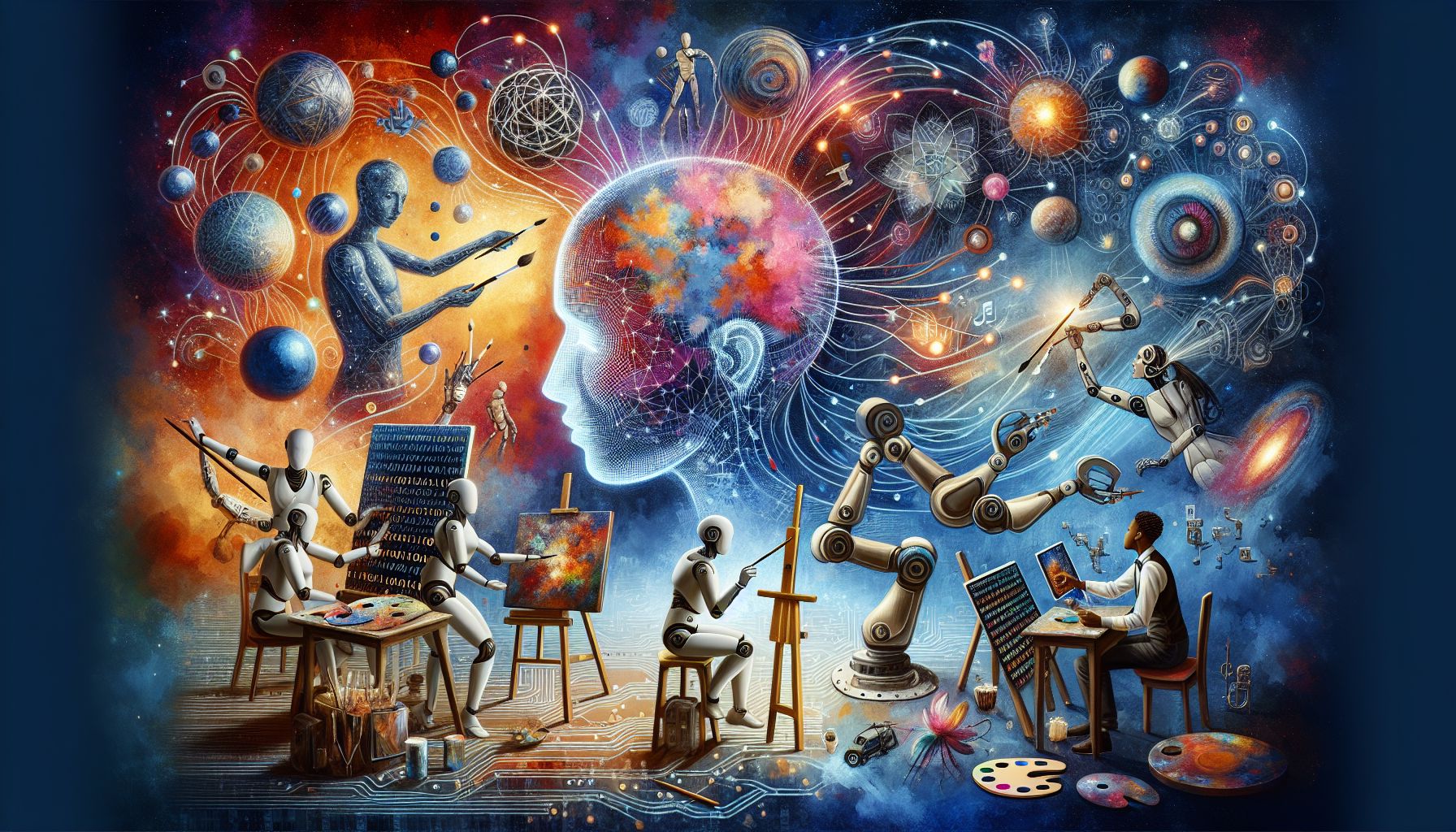
Hey, fellow tech enthusiasts! Today, we’re diving into something that’s transforming the world right under our noses—Artificial Intelligence in creative arts. It’s the kind of breakthrough that makes you say, “We’re living in the future,” which, let’s be honest, we all secretly love to say. So, grab your favorite cup of Joe, snuggle into your gaming chair, and let’s unravel how AI is painting new colors onto the creative canvas. Spoiler: It’s like Bob Ross but with algorithms.
The Intersection of Bytes and Brushes
You know that moment when you hear a song or see a piece of art, and something, somewhere inside you clicks? Well, imagine an AI can now generate those masterpieces—music pieces that give you goosebumps or paintings that stir emotion. AI in creative arts isn’t just about producing art; it’s about reshaping what we consider possible in both how and who creates art.
AI as the Co-pilot, Not the Pilot
There’s a common fear that AI will replace human creativity. It’s easy to picture a dystopian art world where robots churn out Shakespearian-level sonnets by the minute. But AI isn’t really about ditching the human touch; it’s about enhancing it. Think of AI as a creative partner, a co-pilot riding shotgun. Take Google’s DeepDream for instance. This neural network doesn’t just mimic human creativity; it becomes a muse, inviting artists to collaborate and explore unexpected pathways.
Case Study: Music and AI
Have you caught wind of OpenAI’s Jukebox? It’s this mind-blowing neural net that churns out complete songs in the styles of various genres and artists. And we’re not talking ringtone-level simplicity here. Jukebox creates complex compositions that wouldn’t be out of place on a Spotify playlist. Musicians are using this technology to experiment, composing pieces they might never have conceived on their own.
Where Logic Meets Imagination
AI isn’t just a tool. It’s like the coolest new band member who’s been classically trained yet has a penchant for edgier stuff. It’s that guy who can play both Bach and Post Malone at whim.
The Creative Process: Enhanced
Companies like RunwayML are building AI tools that artists use to enhance their workflow. Ever thought about writing your great novel but struggled with outlining or editing? That’s where AI like Sudowrite comes in. It can help brainstorm ideas or even provide alternative narrative paths you may not have considered.
In visual arts, projects like Artbreeder allow artists to manipulate pin-point details of an image. You can literally morph hundreds of images through genetic algorithms to create something truly novel. AI helps multitask and speed up time-consuming processes, leaving more room for spontaneous creativity.
Ethical Debates and Copyright Quandaries
Of course, it isn’t all rainbows and unicorns when it comes to AI in creative arts. Questions around ethics and intellectual property swarm this tech frontier like mosquitoes on a warm summer night. Who owns these AI-generated creations? The programmer? The AI software company? The machine itself?
Navigating the Gray Areas
In real-world applications, companies like OpenAI are treading carefully. They frequently iterate and update their models to balance accessibility with ethical implications. For instance, restrictions on AI-generated content are subject to constant debate in legal circles, so much so that future regulations may end up reshaping this exciting new ecosystem.
A Snapshot of What’s Next
The road ahead? It’s going to be wild. AI will continue to evolve, blurring the lines between machine and human creativity even further. We might witness the birth of entirely new art forms, fueling our imagination, igniting our emotions, and prompting us to question the very essence of what it means to be human.
Possible Futures (Speculation Alert!)
Germany recently launched a two-year project called “AI x Music”. It explores intersections where AI generates compositions that musicians can then manipulate. Imagine a world where concerts are algorithmically dynamic, ever-evolving and never the same performance twice. Similarly, the Metaverse could house entire museums filled with AI-curated, ever-updating exhibits, open to global tours.
Conclusion: Welcome to the Renaissance 2.0
We stand on the edge of a new Renaissance, one where technology and creativity dance together in a splendidly digital waltz. While AI is an undeniably potent tool, its true magic lies in collaboration, existing as an extension of our complex human brains. So, whether you’re a composer, writer, artist, or a simple tech dabbler like yours truly, now is the time to dive into and become a part of this incredible AI-powered artistic revolution.
Until next time, keep exploring, creating, and wondering. AI isn’t the future. We are, together.